The Beckham Law in Spain is a special tax regime originally designed to attract highly qualified professionals from other countries to work in Spain. Formally, the tax regime is called the Special Tax Regime applicable to workers, professionals, entrepreneurs, and investors moving to Spanish territory (in Spanish, Régimen fiscal especial aplicable a los trabajadores, profesionales, emprendedores e inversores desplazados a territorio español), provided for in Article 93 of Law 35/2006, of November 28, on the Personal Income Tax in Spain, but it is commonly known as the Beckham Law due to David Beckham, a famous English footballer who was one of the first public figures to benefit from this tax regime after his arrival at Real Madrid.
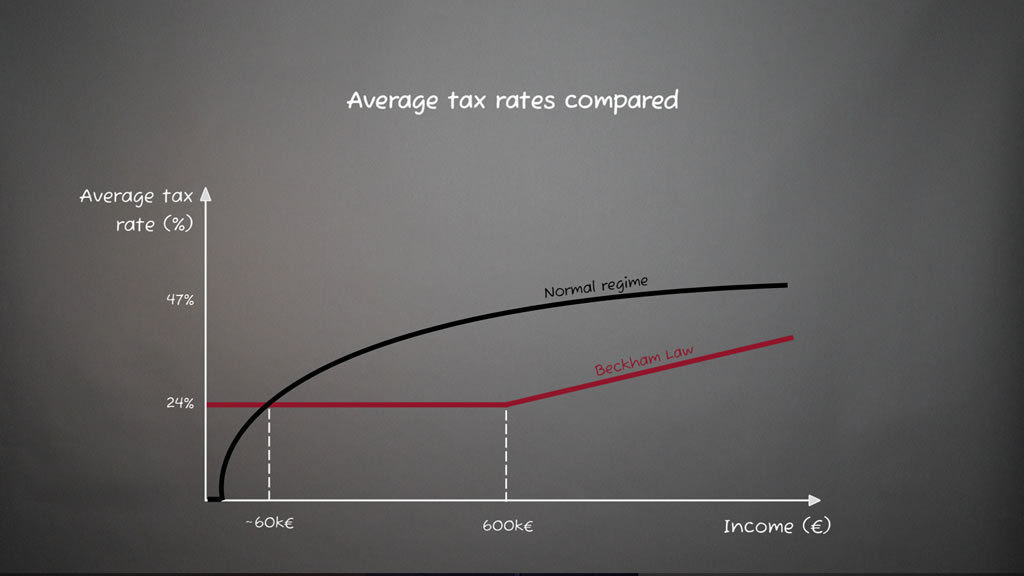
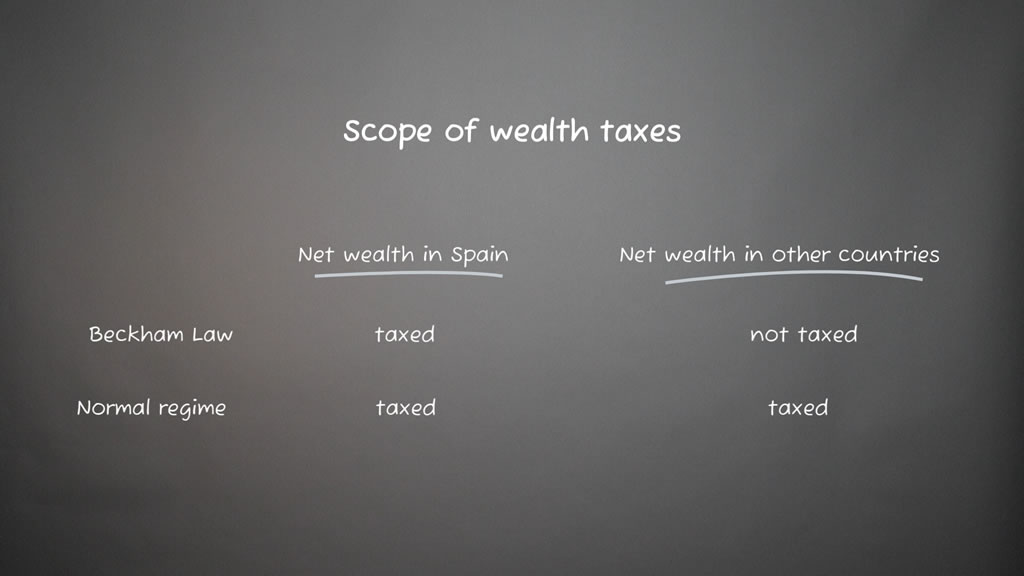
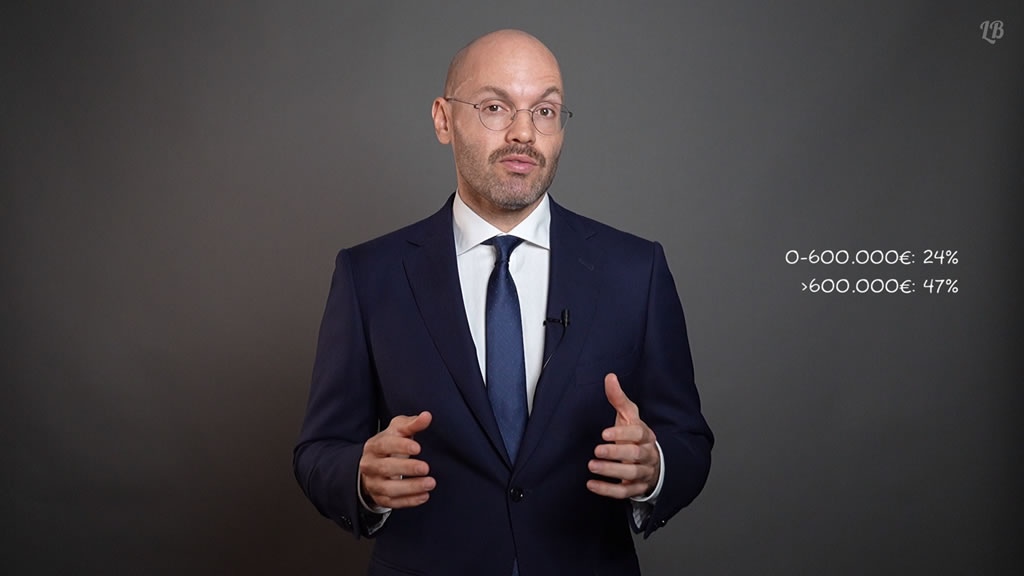
This regime essentially allows workers who move to Spain to pay taxes as if they were non-tax residents, despite technically being considered tax residents in the country. Its main advantage is that, in general, those who benefit from the Beckham Law only pay taxes on the income generated in Spain and at a tax rate usually lower than that applicable to other residents with that level of income.

The Beckham Law, in its current version today (it has varied over the years), offers several key advantages to workers moving to Spain, focused on providing a more favorable tax regime. The main advantages are briefly described below:
These are just some of the advantages that make the Beckham Law a very attractive tax regime for those considering establishing their residence in Spain, especially those with high incomes and/or considerable wealth. However, it is crucial to bear in mind that there are certain requirements and conditions to benefit from this regime.
The Beckham Law is undoubtedly a very interesting regime for people with high incomes and/or considerable wealth. Why don’t more people benefit from this regime? In some cases, it is simply due to lack of knowledge, but in the majority of cases, it is because they do not meet the requirements needed to benefit from this regime. In this regard, the following fundamental requirements could be highlighted:
These are just some of the requirements, and each requirement has different ramifications, so it is advisable to thoroughly study this aspect before making any decisions.
The Beckham Law, formally called the Special Tax Regime applicable to workers, professionals, entrepreneurs, and investors moving to Spanish territory, was a legislative initiative launched in Spain in the year 2005. Its primary objective was to encourage the arrival from other countries of highly qualified professionals and executives, incentivizing their move to Spain through an attractive fiscal regime. This regime allowed such workers coming from abroad, once relocated in Spanish territory, to be taxed as non-fiscal residents for a limited period of time, which represented a considerable fiscal benefit for these workers.
Although the law was aimed at a wide range of professionals, its most visible and controversial impact was in the field of professional football. The nickname “Beckham Law” comes from the famous English footballer David Beckham, who was one of the first celebrities to benefit from this legislation after his arrival at Real Madrid.

The law established that these workers, despite residing in Spain, would only be taxed on the income obtained in the country (instead of their worldwide income, which would be normal for any other taxpayer in Spain), and at a lower tax rate than that applied to other fiscal residents with that level of income. For individuals with high incomes, such as elite footballers, this was a great opportunity to maximize their net income. This fiscal regime was not only advantageous for the players but also for the clubs that, by being able to offer better net conditions, could compete on better terms in the international transfer market.
However, the Beckham Law was not without controversy. Although the initial purpose was to attract international talent and experience in various professional areas, a part of society focused the debate on how high-level athletes were benefiting disproportionately, in their view. This situation generated a debate on equity and fiscal justice, questioning whether it was fair for individuals with such high incomes to have these types of fiscal advantages.
In response to these criticisms from a part of society, the Spanish government modified the Beckham Law to limit its scope. As a result of this modification, professional athletes were excluded from the regime (probably the most mediatic measure), limits were established on the amount of income that could be included in the special regime, and the period during which workers could benefit from this regulation was reduced. These reforms sought to realign the Beckham Law with its initial objectives of attracting talent to Spain, thus ensuring that the benefit was not exclusively centered on one sector, such as sports.
As a result of the above, from this reform onwards, the Beckham Law began to be perceived more and more as a mechanism focused on attracting talent, not so much linked with the world of football, but with the technology sector, and the business world in general.
The world has changed since the last reform. We are now facing an increasingly globalized economy, driven by the success of digital companies and access to a vast amount of information on the internet. In this context, the Spanish government has decided to take measures to try to create ecosystems that facilitate the attraction of talent and investment, focusing on the promotion of so-called digital nomads, the development of innovative startups, and the attraction of specialized investors.
The Law 28/2022, of December 21, on the promotion of the startup ecosystem, responds to this context, forming part of Spain’s Recovery, Transformation, and Resilience Plan. It includes strategies to support entrepreneurship and facilitate investment in startups, especially in technology. The objective of this law is, therefore, to reduce legislative and fiscal obstacles for these companies, promote investment in innovation, and strengthen public-private collaboration. The aim is to position Spain as an attractive destination for professionals and digital nomads, thus contributing to economic growth and the modernization of the country’s business fabric. Below is an excerpt from the preamble of the law, which highlights this objective:
[…]
In Spain, an emerging startup ecosystem has developed around certain hubs of talent, capital, and entrepreneurs, which stand out in the European landscape. Beyond urban centers, it is essential to promote the development of startup hubs in peripheral cities, as well as in rural environments, favoring the interrelation of these companies and the territories to increase their chance of success. By increasing innovation rates across the territory, beyond urban concentrations, a network of opportunities can be configured for all citizens regardless of their place of residence, promoting the deconcentration of population and activities and promoting equality of rights and opportunities throughout the territory.
To strengthen this emerging ecosystem and to drive these types of companies as one of the engines of recovery and modernization of the Spanish economy, the Recovery, Transformation, and Resilience Plan includes the Spain Entrepreneurial Nation Strategy, which encompasses, among other measures: support for entrepreneurship, with special attention to female talent, the development of financial instruments to boost initial and growth investment in startups in disruptive technologies, the National Entrepreneurship Office (ONE) as a one-stop-shop of services for digital entrepreneurs and startups, as well as various normative projects to facilitate the creation of companies, their growth and restructuring, among which stands out the present law, placing Spain at the forefront in this field, with a set of specific measures in the fiscal, commercial, civil, and labor areas aligned with the programs of the most advanced countries and with European standards in the matter, in particular the recently signed European entrepreneurial nation standard (EU startup nation standard).
Startups have specific characteristics that make it difficult to fit them into the traditional regulatory framework. First, the high risk derived from their high innovative content, uncertainty about the success of their business model, which complicates financing in the initial phases, as it requires capital to mature and test their ideas before the company starts generating revenue; second, the potential for exponential growth through economies of scale, which requires significant capital investments to allow rapid expansion in case of success; third, their dependence on attracting and retaining highly qualified and productive workers from the initial phases of the company, when there is no revenue flow to remunerate them through traditional salary instruments; and finally, exposure to strong international competition for capital and foreign talent.
All these characteristics of startups fit poorly with traditional regulatory frameworks in the fiscal, commercial, civil, and labor areas. This justifies a differentiated treatment compared to companies with conventional business models. For this reason, the competition for the attraction of investment and talent in the new digital economy has led to different startup promotion programs in our surroundings, which usually incorporate three main elements: (i) tax benefits for entrepreneurs, workers, and investors, (ii) reduction of administrative obstacles and facilitation of visas, and (iii) flexibility in company management and the application of commercial and bankruptcy principles.
Furthermore, Spain has significant assets for attracting highly qualified professionals who carry out their activity, whether self-employed or employed, using electronic tools. It is the first country in the deployment of fiber optics within the European Union, which provides good connectivity conditions, even in rural areas. Along with this determinant aspect for these workers, other more subjective characteristics can be highlighted, such as the benign climate, lifestyle, public safety, culture, gastronomy, excellent universities, and the existence of a growing number of research and development clusters and creative industries, around which an international ecosystem of professionals develops, making our country one of the most attractive destinations for remote workers.
The attraction of these types of profiles has positive effects on their new place of residence. The most obvious is economic: these are highly qualified professionals whose income from abroad is spent living in the environment of their choice. They contribute to activating consumption, with the consequent impact on the local economy. In addition, through their connections, they enrich the local talent and generate a network and value opportunities for other professionals. This is especially valuable in innovation environments and entrepreneurial ecosystems, such as the audiovisual sector, among others.
In this context, the present law incorporates a significant set of measures that respond to the result of the intense public consultation process and the public hearing of the draft bill. These measures significantly reduce the obstacles detected in the creation and growth of these companies of a legislative nature, mainly referred to fiscal and social charges, the requirements of commercial law, and bureaucratic procedures. In addition, the law promotes investment in innovation, boosts public support instruments for the startup ecosystem, and reinforces public-private collaboration to drive the growth of these companies. Finally, it favors the establishment in Spain of entrepreneurs and workers of this type of companies, as well as remote workers of all types of sectors and companies, known as “digital nomads.”
[…]
Fourthly, access to the special tax regime applicable to workers displaced to Spanish territory is improved with the aim of attracting foreign talent. In particular, the number of tax periods prior to displacement to Spanish territory during which the taxpayer must not have been a fiscal resident in Spain is reduced from ten to five years, making access to the regime easier. In addition, the subjective scope of application of the regime is extended to employed workers, allowing its application to workers who, whether or not ordered by the employer, move to Spanish territory to work remotely using exclusively electronic, telematic, and telecommunications means and systems, as well as to administrators of startups regardless of their shareholding percentage in the capital of the entity. Moreover, the possibility of opting for the special regime, that is, opting for taxation under the Non-Resident Income Tax, is established for the taxpayer’s children under twenty-five years of age (or any age in the case of disability) and for their spouse or, in the absence of a marital link, the parent of the children, provided they meet certain conditions.
[…]
In terms of the Beckham Law, the 2023 reform essentially meant a relaxation of access requirements and expanded the scope of the original law to include a wider variety of professionals (entrepreneurs, remote workers, etc.).