The Special Tax Regime applicable to workers, professionals, entrepreneurs, and investors moving to Spanish territory (in Spanish, Régimen fiscal especial aplicable a los trabajadores, profesionales, emprendedores e inversores desplazados a territorio español), provided for in Article 93 of Law 35/2006, of November 28, on the Personal Income Tax in Spain, commonly known as the Beckham Law, entails a tax treatment with many advantages but also some disadvantages compared to the treatment any other taxpayer of the Personal Income Tax (“IRPF”) in Spain would receive. The differences are mainly related to the applicable tax rates and the income taxed, although there are also other important aspects to consider. The main advantages and disadvantages of the Beckham Law are summarized in the following sections.
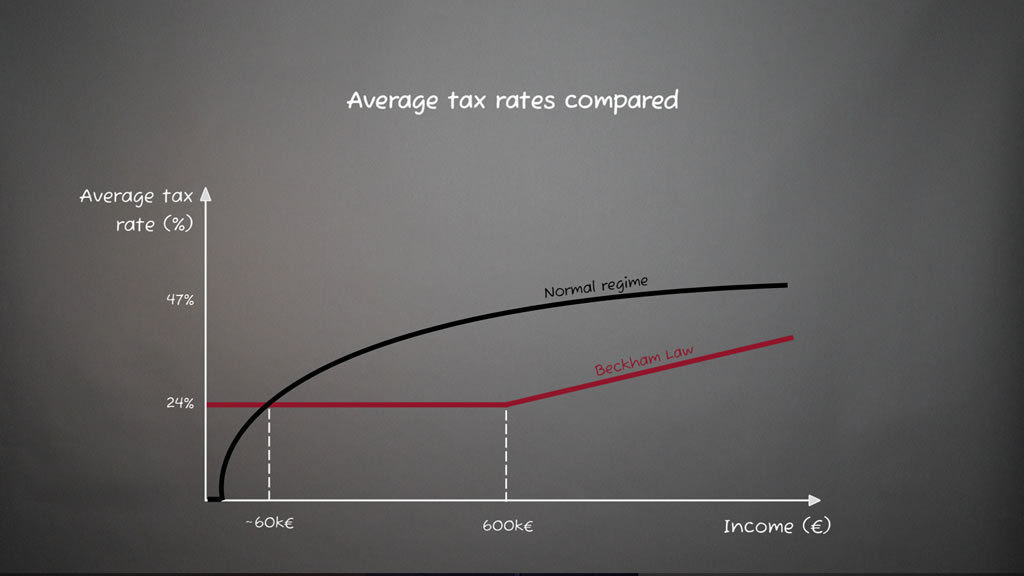
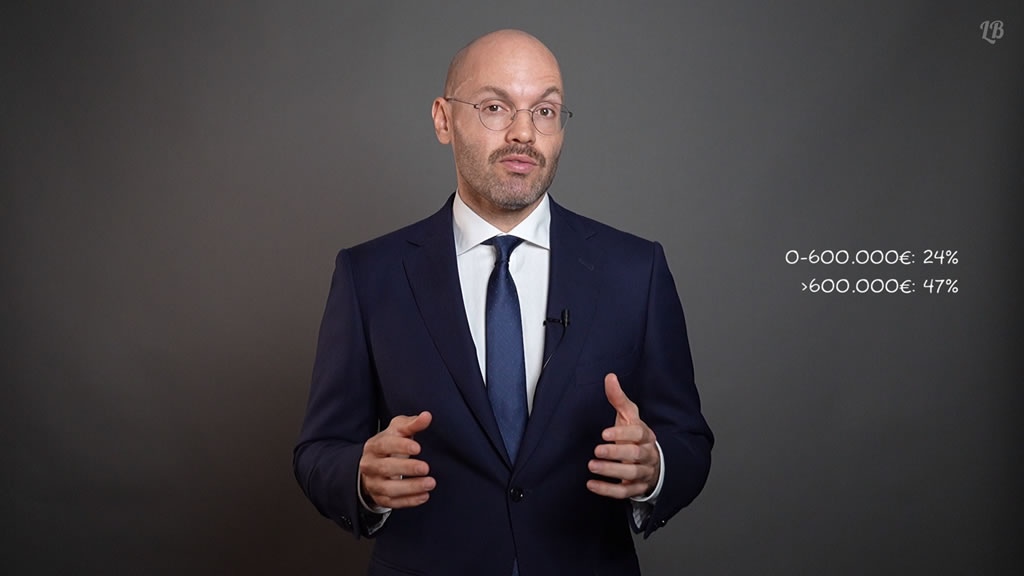
One of the main advantages of the Beckham Law, depending on the case, is that income from the general taxable base (employment income, economic activity returns, rentals in Spain, etc.) is taxed at an almost fixed rate of 24%. That is, the first 600,000 euros of income (each year) are taxed at 24%, and any amount above this is taxed at 47%.
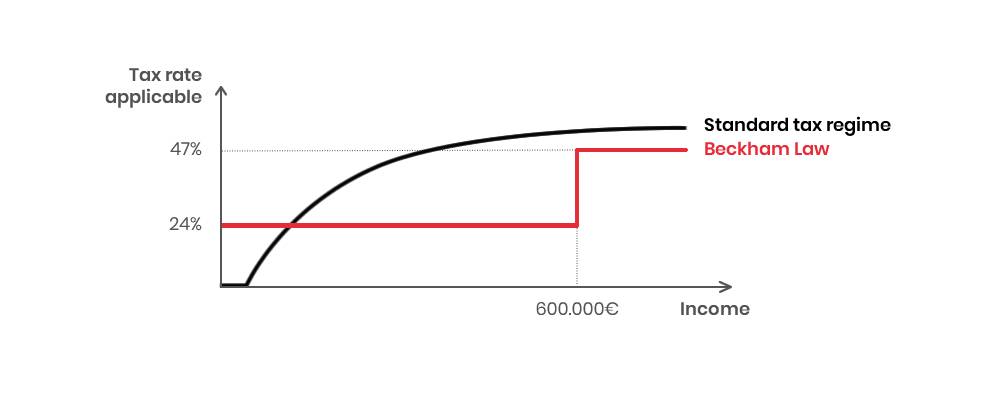
To put these figures into context, a fiscal resident in Spain, not covered by the Beckham Law, would be taxed at a progressive tax rate that starts very low but could go up to almost 50% as income increases.
As a result, the Beckham Law’s semi-fixed tax rates (24%/47%) could be beneficial if the volume of income included in the general taxable base is high but counterproductive if it is low. The reason is that the tax rates of the general regime can even be 0% for taxpayers with very low incomes. As income increases, so do the tax rates.
Determining the threshold between both regimes is not easy, among other reasons because the applicable tax rates with the normal regime depend on each autonomous community. For example, Madrid has different tax rates than Barcelona. However, just to give a general idea, the threshold is usually between 55,000 and 60,000 euros of income (in the general taxable base). In general, it is better to choose the general regime if you earn less than these amounts, whilst the Beckham Law would be better if you earn more.
In addition to the general taxable base, there is the savings taxable base. The latter includes various types of income such as dividends, interest, or capital gains obtained from the transfer of assets (real estate, shares, etc.). These incomes are taxed at the same rates whether the Beckham Law applies or not, i.e., with a progressive tax rate of 19% to 28%.
Taxpayers not covered by the Beckham Law, pay taxes in Spain for all their worldwide income. Precisely, one of the benefits of the Beckham Law is that those who benefit from this special regime only pay taxes in Spain for local income, i.e., income earned in Spain.
There are two exceptions to this last rule, employment income and income derived from an economic activity. With the Beckham Law, employment income and income derived from an economic activity (from one of the allowed activities compatible with the Beckham Law) are taxed in Spain, regardless of their origin, whether from Spain or another country. This does not necessarily mean that you will pay taxes twice on the same income (in the country where you generated the income and in Spain) since there is a mechanism to avoid double taxation, through which the amount of taxes paid abroad can, under certain circumstances, be used as a tax credit in Spain. In any case, this mechanism has its limitations, so it is advisable to assess each case individually.
| INCOME TAXABLE IN SPAIN | Standard tax regime | Beckham Law |
|---|---|---|
| Employment income | Global | Global |
| Income derived from an economic activity | Global | Global |
| Rental income | Global | Local |
| Capital gains | Global | Local |
| Dividends | Global | Local |
| Interests | Global | Local |
| … | … | … |
The good thing about the Beckham Law is that you would not have to pay taxes in Spain for the rest of the income generated abroad, such as rental income, dividends, interest, capital gains, etc. You may have to pay taxes for each of these incomes in the country where they are generated, which depends on the regulations of each country, but at least they would not be subject to taxation in Spain.
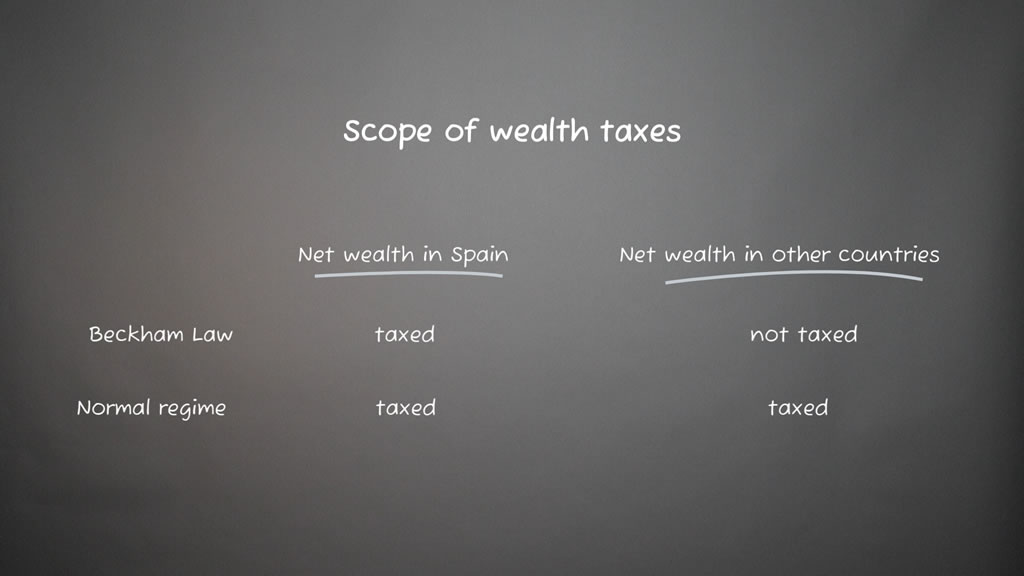
In Spain, two taxes are currently in force that apply based on your global net wealth value, which includes any type of assets (money, real estate, shares, company shares, life insurance, cryptocurrencies, etc.) located anywhere in the world:
Another benefit of the Beckham Law is that you would only be subject to the aforementioned taxes for assets located in Spain. That is, any other fiscal resident in Spain has to consider their global net wealth, while someone covered by the Beckham Law only has to consider their assets located in Spanish territory.
| NET WEALTH TAXABLE IN SPAIN | Standard tax regime | Beckham Law |
|---|---|---|
| Money | Global | Local |
| Real estate | Global | Local |
| Shares | Global | Local |
| … | … | … |
This does not affect the tax burden (the taxes to be paid), but it is another of the benefits of the Beckham Law. The fact is that, if the Beckham Law is applied instead of the normal IRPF (Personal Income Tax), there is no obligation to submit the Form 720 or Informative declaration on goods and rights held abroad.
The Spanish government introduced the Form 720 (in Spanish “Modelo 720”) in 2012, in an effort to reduce international tax evasion practices. This declaration must be filed annually by all tax residents in Spain who own assets located abroad worth more than €50,000 for each type of asset. In other words, more than €50,000 in real estate, more than €50,000 in stocks, etc.
It is only an informative declaration, meaning that it does not result in any amount to be paid. However, if the declaration is not submitted, or is submitted incorrectly, the penalties can be significant. Added to this is the considerable level of detail required in the declaration and, therefore, the significant workload involved in its preparation. For all the above reasons, the Form 720 becomes a relevant aspect to consider when assessing the suitability of the Beckham Law.
One of the main disadvantages of opting for the Beckham Law is that certain exemptions and deductions available under the general regime of the Personal Income Tax (IRPF) do not apply.
Firstly, taxpayers under the Beckham Law cannot benefit from the exemptions of Article 7 of the IRPF Law. That is, under the Beckham Law, these incomes would be taxed like any other income. Below are some examples of incomes that would not be exempt under the Beckham Law:
Additionally, there are restrictions regarding deductions. For example, taxpayers are not entitled to deduct expenses such as Social Security or the minimum family or for descendants. This means that certain tax benefits that would reduce the tax burden under the general IRPF regime are not available for those who opt for the Beckham Law.
Lastly, it is worth noting that under the Beckham Law, the tax benefit for contributions to pension plans or other social security systems will not apply. That is, these amounts will also be taxed at 24%, like the rest of the employment income.
Another disadvantage of being under the Beckham Law is related to the taxation of real estate in Spain. In this sense, taxpayers under the Beckham Law cannot deduct expenses related to real estate income, whereas in the general regime of the Personal Income Tax (IRPF), owners can deduct certain expenses associated with their rented properties, such as repairs, maintenance, mortgage interests, among others.
In summary, for taxpayers under the Beckham Law, the tax treatment of real estate in Spain is less favorable compared to the general IRPF regime, due to the lack of deductions for real estate expenses and the obligation to pay imputed income tax for the habitual residence.
Another con of the Beckham Law is that it is incompatible (except in certain cases) with working as independent professionals in Spain. This means that, under the Beckham Law, taxpayers cannot engage in freelancer economic activities or be self-employed, except in specific cases expressly provided by the law (undertaking entrepreneurial activity; providing services to start-up companies; or carrying out training, research, development, and innovation activities).
This also affects the income obtained through tax-transparent or “pass-through” entities, such as the “Limited Liability Company (LLC)” from the United States, the “Limited Liability Partnership (LLP)” from the United Kingdom, or the “Kommanditgesellschaft (KG)” from Germany. The incomes derived from such tax-transparent entities are directly attributed to their partners. Given the above, the issue is that, depending on the circumstances, the Spanish Tax Agency could consider that such incomes have been obtained through a permanent establishment located in Spanish territory, which would be incompatible with the Beckham Law.
However, what would generally be allowed is to carry out an economic activity through an entity that is not transparent for tax purposes, such as a Limited Company (SL) incorporated in Spain, though professional activities must be considered as a separate case.
In summary, the Beckham Law establishes strict limits regarding freelancing, allowing it only in very particular circumstances, which represents a limitation for those taxpayers looking to develop activities as independent professionals while benefiting from the Beckham Law.
Many Double Taxation Treaties are not applicable under the Beckham Law, meaning that the advantages offered by these treaties cannot be utilized by taxpayers under this special regime. This situation can sometimes lead to cases of double taxation, where income may be subject to taxation both in Spain and another country.
However, it is important to note that the Beckham Law also includes its own mechanisms to avoid or reduce double taxation. These internal mechanisms allow, under certain circumstances, taxpayers to reduce their tax burden in Spain in relation to the taxes they have paid in other countries. This system seeks to prevent taxpayers from enduring excessive taxation on the same income in different jurisdictions.
Although the incompatibility of certain Double Taxation Treaties may seem like a considerable disadvantage of the Beckham Law, the internal mechanisms it offers to avoid double taxation are usually quite effective. In general, these internal mechanisms help ensure that it does not become a major problem for most taxpayers under the Beckham Law.